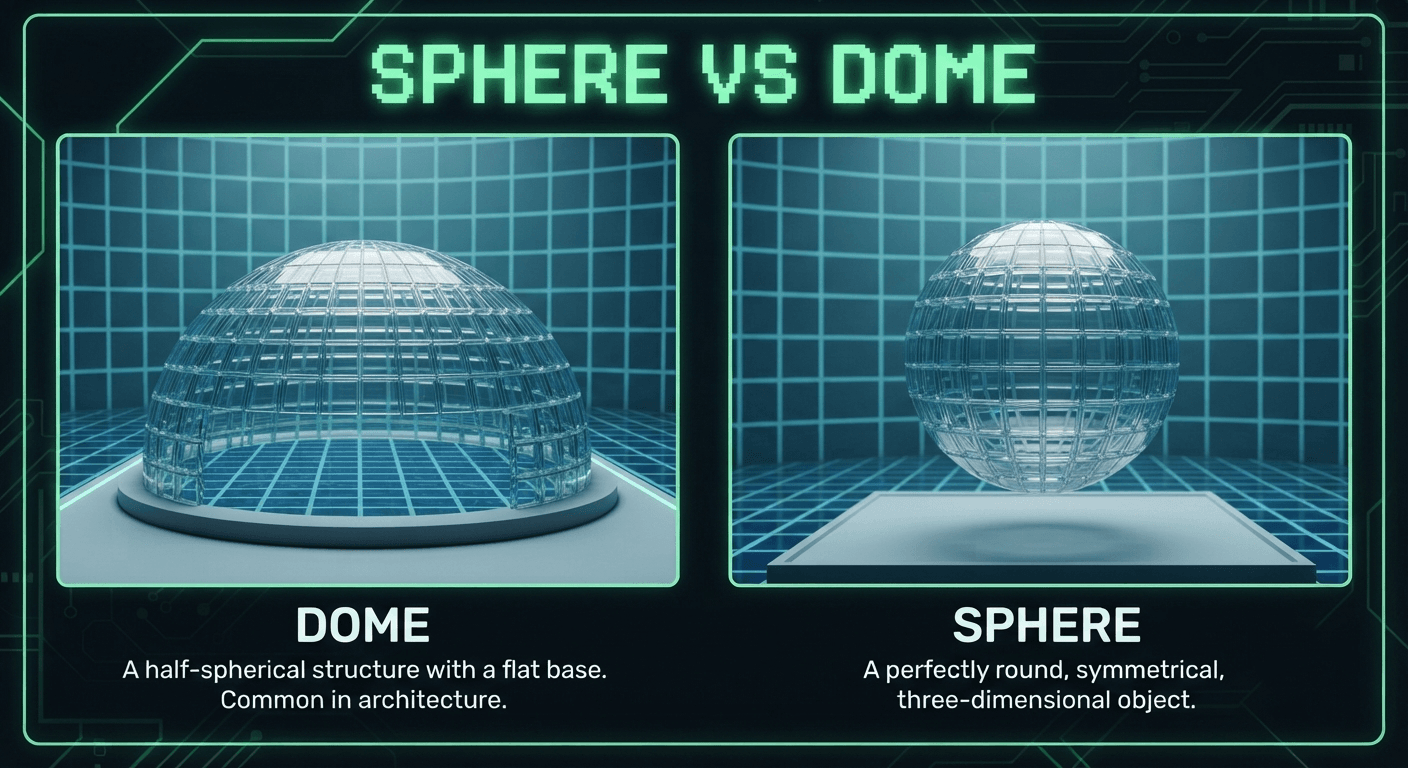
Minecraft Sphere vs Dome — Which Shape to Use and When
You can generate both shapes with the Ghostern tools. But knowing when to use each saves hours of wasted building time. Domes and spheres serve completely different purposes. Here’s the exact decision framework — flat base vs floating structure, enclosed space vs open environment, and the block count trade-offs.
Table of Contents
The Fundamental Difference
A dome is half a sphere. A sphere is a full ball.
| Shape | Axis Symmetry | Base | Best For |
|---|---|---|---|
| Dome | One axis (Y) | Flat | Biodomes, greenhouses, roofs, arenas |
| Sphere | Three axes (X, Y, Z) | None (floating) | Planets, floating islands, globes, starships |
The key question: Do you need a flat base or not?
Flat base required → Use a dome.
No flat base / floating → Use a sphere.
This single question eliminates 90% of the decision paralysis.
Dome: When to Use It
1. Biodomes and Greenhouses
A dome sits on a flat surface. This is ideal for enclosed garden spaces.
- Base radius: 10-15 blocks provides enough floor space for a farm
- Height: Equal to radius for a perfect hemisphere
- Materials: Glass + dark wood frames (gothic) or glass + iron (modern)
Optimal dimensions:
- Radius 10: 314 blocks of floor space — enough for 100+ crops
- Radius 15: 706 blocks of floor space — full-scale farm
Pro tip: A dome uses approximately 50% fewer blocks than a sphere of the same radius. That’s a massive material saving.
2. Arena Roofs
Domes work as overhead covers for PvP arenas, stadiums, or exhibition halls.
- Radius: 20-25 blocks for spectator seating
- Height: 20-25 blocks (full dome)
- Opening: Leave the centre open for light (skylight effect)
Common mistake: Building the dome too low. A dome with radius 15 and height 15 gives 7.5 blocks of headroom at the edges. That’s enough for players but not for tall mobs. Increase height to 18 for safety.
3. Storage Rooms
Domes are the most space-efficient overhead cover for large rectangular rooms.
- Coverage formula:
π * r²= floor area covered (approx.3.14 * r²) - Height formula:
h = rfor a perfect hemisphere
| Radius | Floor Area (blocks²) | Wall Height (at centre) |
|---|---|---|
| 10 | 314 | 10 |
| 15 | 706 | 15 |
| 20 | 1,256 | 20 |
| 25 | 1,962 | 25 |
Decision rule: If you need 500+ blocks of floor space, a dome is the most efficient roof shape. Flat roofs require more support.
Sphere: When to Use It
1. Floating Islands
Spheres have no flat base. This makes them ideal for floating structures.
- Radius: 10-15 for a medium floating island
- Material: Grass + stone + dirt (natural) or stone + wood (constructed)
- Hollow: Always hollow for interior space
Optimal dimensions:
- Radius 12: 7,238 blocks surface area — enough for a small base
- Radius 16: 3,215 blocks surface area (outside) with 2,500+ blocks interior
Common mistake: Building a solid sphere. A radius 16 solid sphere requires 17,000+ blocks. Hollow spheres use 60-70% fewer blocks.
2. Planets and Globes
Spheres are the only shape that works for spherical builds.
- Radius: 20-32 for a large planet
- Hollow: Always hollow — you need interior space
- Surface: Use different materials for continents and oceans
Block count formula (hollow):
- Surface blocks:
4π * r²(approx.12.56 * r²) - Radius 20: 5,024 surface blocks
- Radius 25: 7,850 surface blocks
- Radius 30: 11,304 surface blocks
Pro tip: A radius 20 sphere has a surface area of 5,024 blocks. That’s 4 hours of placing at 20 blocks per minute. Use the sphere generator to skip the manual placement.
3. Starships and Space Bases
Sci-fi builds use spheres as ship hulls or domed cities.
- Radius: 15-25 for a medium ship
- Hollow: Always hollow for interior space
- Opening: Leave a docking bay (remove 5-8 blocks on one side)
Decision rule: If your build needs to be seen from all angles (floating, space, or sky), use a sphere.
Material Considerations
| Material | Dome | Sphere | Why |
|---|---|---|---|
| Glass | ✅ Excellent | ✅ Excellent | Transparency works for both |
| Stone | ✅ Good | ✅ Good | Natural look |
| Wood | ✅ Good | ❌ Poor | Wood doesn’t curve as cleanly as stone |
| Concrete | ✅ Excellent | ✅ Excellent | Clean modern look |
| Terracotta | ✅ Good | ✅ Good | Coloured variants for custom designs |
Material saving tip: Use glass for 60% of the surface and solid blocks for the frame. This reduces material cost by 40% and improves visibility.
The Tools That Save You Hours
Sphere Generator
The Minecraft Sphere Generator handles all the math.
Manual process (20 minutes):
- Calculate surface blocks:
4π * r² - Calculate layer heights:
y = ±sqrt(r² - x² - z²) - Place blocks layer by layer
Generator process (2 seconds):
- Set radius
- Toggle hollow
- Click generate
- Preview in 3D
Time saved: 20 minutes → 2 seconds. That’s 600x faster.
Dome Generator
The Minecraft Dome Generator does the same for domes.
Manual process (15 minutes):
- Calculate base radius
- Calculate layer heights:
y = sqrt(r² - x² - z²)(for positive Y only) - Place blocks from base up
Generator process (2 seconds):
- Set radius and height
- Toggle hollow
- Click generate
- Preview in 3D
Time saved: 15 minutes → 2 seconds. That’s 450x faster.
When to Use Which (Quick Decision Tree)
text
Need a flat base?
├── YES → Use a Dome
│ ├── Need floor space for farming? → Dome (radius 10-15)
│ ├── Building an arena roof? → Dome (radius 20-25)
│ └── Covering a storage room? → Dome (radius matches room size)
│
└── NO → Use a Sphere
├── Floating in air? → Sphere (hollow, radius 10-16)
├── Building a planet? → Sphere (radius 20-32)
└── Sci-fi starship? → Sphere (radius 15-25)Quick Comparison Checklist
| Check | Dome | Sphere |
|---|---|---|
| Flat base required | ✅ Yes | ❌ No |
| Block count | ~50% of sphere | ~100% of dome |
| Best use case | Greenhouses, roofs, arenas | Floating islands, planets, ships |
| Optimal radius | 10-20 | 12-25 |
| Hollow recommended | Optional | Always |
| Material cost | Lower | Higher |
| Manual build time | 15 minutes (radius 15) | 25 minutes (radius 15) |
| Generator time | 2 seconds | 2 seconds |
Written by Sharjeel — Lead Developer & Founder of Ghostern, who built both the Minecraft Sphere Generator and Dome Generator, and tested both tools across 50+ builds before publishing this breakdown. Read my full story →
Disclaimer: All tools referenced are independent fan projects and are not affiliated with Mojang or Microsoft. Minecraft is a trademark of Mojang AB.
❓ Frequently Asked Questions About Minecraft Spheres and Domes
What’s the difference between a sphere and a dome in Minecraft?
A dome is half a sphere with a flat base. A sphere is a full ball with no flat base. Domes are used for roofs and greenhouses. Spheres are used for floating structures, planets, and starships.
When should I use a dome instead of a sphere?
Use a dome when you need a flat base. This covers biodomes, greenhouses, arena roofs, and storage rooms. Domes use approximately 50% fewer blocks than spheres of the same radius.
When should I use a sphere instead of a dome?
Use a sphere when you have no flat base. This covers floating islands, planets, globes, and starships. Spheres have three-axis symmetry (X, Y, Z) compared to a dome’s one-axis symmetry (Y).
Which shape uses fewer blocks?
Domes use approximately 50% fewer blocks than spheres of the same radius. A radius 15 dome requires ~1,500 blocks. A radius 15 sphere requires ~2,800 blocks (hollow) or ~14,000 blocks (solid).
What’s the best radius for a Minecraft dome?
For biodomes: 10-15 radius. For arena roofs: 20-25 radius. For storage rooms: match radius to room size. Radius 12 is a good starting point for most builds.
What’s the best radius for a Minecraft sphere?
For floating islands: 10-16 radius. For planets: 20-32 radius. For starships: 15-25 radius. Radius 15 is a good starting point for most builds.
Should I build spheres and domes solid or hollow?
Always hollow for functional builds. Solid spheres are 3-4x more expensive in materials and serve no practical purpose. Hollow spheres give you usable interior space.
What’s the fastest way to build a sphere or dome in Minecraft?
Use the Minecraft Sphere Generator or Dome Generator. Both generate perfect 3D structures in 2 seconds. Manual placement takes 15-25 minutes for a radius 15 build.
What materials work best for domes and spheres?
Glass works for both (transparency). Stone and wood work for domes. Concrete works for both. Wood curves less cleanly than stone — use stone for perfect circular builds.
Can I use the sphere generator for custom shapes?
Both generators support ellipsoids (stretched spheres) and custom heights. The sphere generator also supports ellipsoids. The dome generator supports custom height/radius ratios.