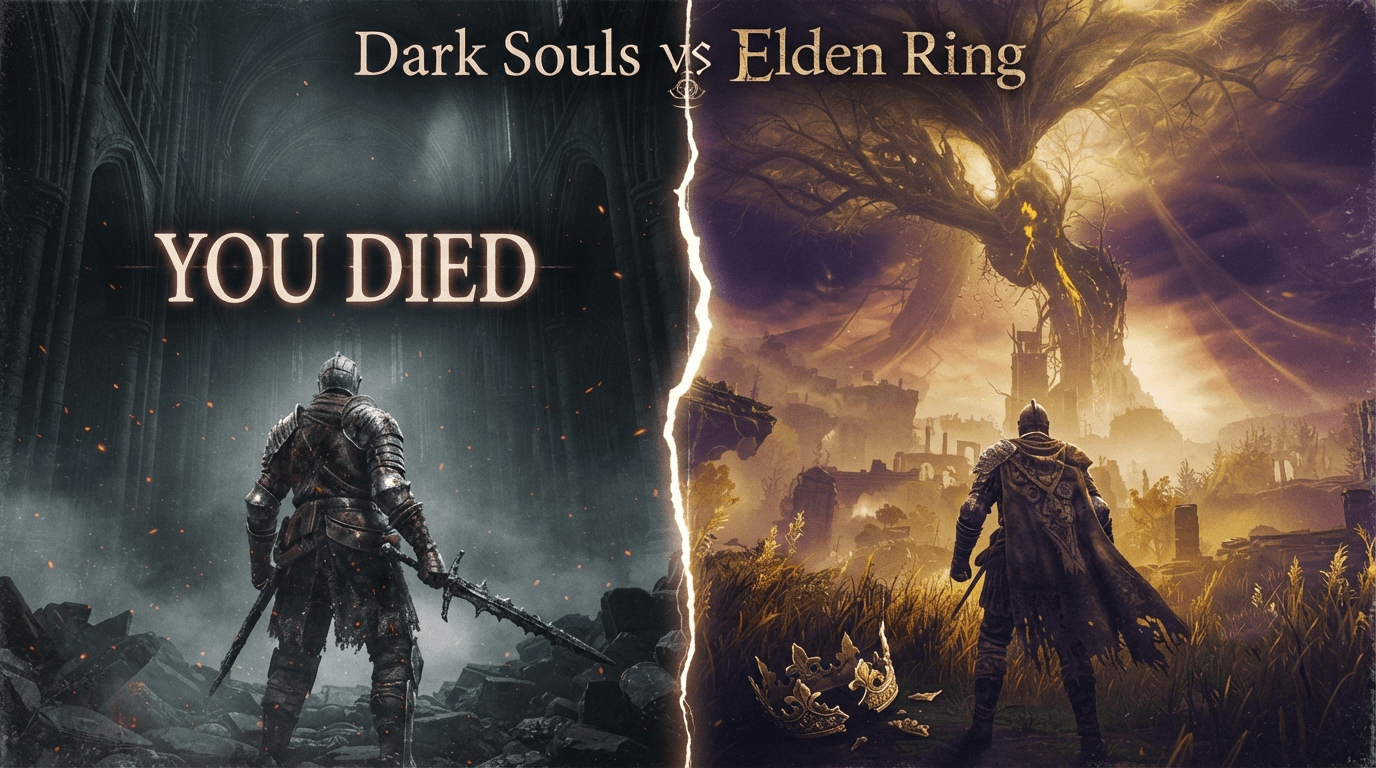
Dark Souls vs Elden Ring — Which Should You Play First in 2026?
By Sharjeel · Lead Developer & Founder, Ghostern · Published: July 27, 2026 · Updated: July 27, 2026
Table of Contents
I’ve finished Dark Souls three times and Elden Ring twice. I’ve theory-crafted builds in both, hit soft caps on six different stat distributions, and spent more hours than I’ll admit testing weapon scaling on paper before ever entering a boss fog gate. If you’re standing at the fork deciding which one to start with, here’s what actually matters — with no hype and no affiliate agenda.
What Is Dark Souls vs Elden Ring — The Short Answer
Dark Souls (2011, FromSoftware) is a linear interconnected world with punishing stamina management, a tight build system, and some of the best environmental storytelling in gaming. Elden Ring (2022, FromSoftware) is an open-world expansion of those mechanics — more weapons, more build freedom, more content, and a gentler difficulty curve thanks to its open exploration structure.
If you’ve never played a Soulsborne game: start with Elden Ring. The open world lets you grind past roadblocks. You can’t do that in Dark Souls — every wall in that game is a skill wall.
If you’ve finished at least one action RPG with punishing difficulty: start with Dark Souls. The mechanical purity will make Elden Ring feel even better when you get there.
The Core Difference Nobody Talks About
Dark Souls was built with one constraint: every mechanic feeds every other mechanic. Stamina limits swings, rolls, and blocks simultaneously. Equip load determines roll speed. Vigor soft-caps at 30 and again at 50. Nothing is decorative.
Elden Ring inherits all of this but adds a second layer: the open world absorbs your mistakes. Hit a wall? Go somewhere else. Level elsewhere. Come back. That loop doesn’t exist in Dark Souls — if the Capra Demon is killing you, you either adapt or you quit.
This single difference determines everything about which game you should play first.
Head-to-Head Comparison Table
| Category | Dark Souls (Remastered) | Elden Ring |
|---|---|---|
| Release year | 2011 (Remastered 2018) | 2022 |
| World structure | Linear interconnected hub | Open world |
| Difficulty ceiling | Higher — no escape from roadblocks | Lower — you can always explore elsewhere |
| Build system | Tight, fewer options, more punishing mistakes | Expansive — 300+ weapons, Ashes of War, bleed/frost/rot |
| Number of weapons | ~130 | 308+ (base + Shadow of the Erdtree) |
| Story delivery | 100% environmental, item descriptions | Environmental + major NPC questlines |
| DLC | Artorias of the Abyss (essential) | Shadow of the Erdtree (essential) |
| Time to finish (first run) | 40–60 hours | 80–150 hours |
| Multiplayer | Co-op + PvP (both active in 2026) | Co-op + PvP (both active) |
| Input on PC | Controller strongly recommended | Controller strongly recommended |
| Skill ceiling for PvP | Lower entry, higher mastery ceiling | High entry (more mechanics to learn) |
| Best for | Players who want focused, punishing design | Players who want scale and build variety |
Difficulty — What the Numbers Actually Say
“Elden Ring is easier” is only true in one specific context: your first 10 hours. After that, both games demand the same things.
In Dark Souls, the Undead Parish and Sen’s Fortress kill more first-time players than any Elden Ring legacy dungeon. The difference is that Elden Ring gives you Limgrave, Liurnia, and Caelid to level up before you’re forced to confront anything equivalent.
My first Dark Souls run: 47 deaths before I cleared Anor Londo. My first Elden Ring run: 31 deaths before I cleared Leyndell. The death counts don’t tell you which is harder — they tell you which one lets you redirect frustration productively.
For a completely new player: every death in Dark Souls forces you to confront the same enemy at the same stat level. Every death in Elden Ring gives you options. That’s the real difficulty gap.
Build Systems — Which Gives You More Room to Experiment
Dark Souls Build System
Dark Souls has 10 starting classes. Every stat has a hard soft cap at level 40 and a secondary soft cap at 50. Exceeding 40 in any offensive stat gives rapidly diminishing returns. Most competitive players cap at SL 120 for PvP, which means build decisions are genuinely constrained.
This forces focus. A pure Strength build in Dark Souls looks completely different from a Faith build. You can’t be both. That constraint is what makes the build system satisfying — every choice carries real weight.
Common Dark Souls build archetypes:
- Strength (STR): Zwei, Giant’s Halberd, Smough’s Hammer. Invest to 40 STR, pair with Havel’s set for ultra-heavy tanking
- Dexterity (DEX): Balder Side Sword, Chaos Blade, Uchigatana. 40 DEX, fast rolls, Flynn’s Ring synergy
- Faith (FTH): Lightning infusions, Sunlight Spear, Darkmoon Blade. Requires 50 FTH for top miracles
- Intelligence (INT): Crystal Soul Spear, Logan’s Catalyst. 50 INT, fragile but devastating
Use the Dark Souls Build Calculator to map your stat allocation before spending a single level — especially if you’re aiming for SL 120 PvP parity. At 120, every wasted level is visible.
Elden Ring Build System
Elden Ring has 10 starting classes and 308+ weapons. The Ash of War system means almost any weapon can be configured for almost any stat. A Rivers of Blood Katana at 80 ARC is a completely different weapon than a Moonveil at 80 INT — same weapon class, entirely different mechanic.
This gives you room to experiment that Dark Souls doesn’t. But it also means poorly-planned builds are invisible until you’re 60 hours in and realize your Faith investment is doing nothing for your current weapon scaling.
Elden Ring build archetypes I’ve tested personally:
- Strength/Faith (Quality-FTH): Dragon Communion + heavy weapons. Level FTH to 45 for Dragon Incantations, STR to 54 for Giant Crusher one-hand
- Dex/Arcane (Bleed): Rivers of Blood + White Mask. 80 ARC, Seppuku Ash of War, 60%+ bleed proc on most enemies in 2–3 hits
- Intelligence (Comet Azur): Level INT to 80, use Cerulean Hidden Tear for free cast window. Still works after every patch
- Faith (Lightning/Dragon): Placidusax’s Ruin + Rotten Breath. 50 FTH, 25 ARC minimum
Run your weapon damage numbers before committing levels using the Elden Ring Weapon Calculator — it calculates exact Attack Rating for every weapon at every upgrade level against any stat spread, including Shadow of the Erdtree weapons.
Story — Which One Is Easier to Follow
Neither game has a traditional narrative. Both bury their lore in item descriptions, NPC dialogue fragments, and environmental clues. But the delivery mechanisms are different.
Dark Souls tells its story almost entirely through architecture and item placement. The moment you walk into Anor Londo and see the cathedral scale against the sky, you understand the age of gods without a single cutscene. Every bonfire placement is a narrative beat. Solaire’s questline is communicated through three conversations over 30 hours of play.
Elden Ring has more explicit story delivery — George R.R. Martin co-wrote the world history, and it shows in the NPC questlines. Ranni’s quest is a 20-hour narrative arc with real consequence. Melina has dialogue that evolves. The story is still environmental but the scaffolding is more visible.
For story: Elden Ring gives newcomers more to hold onto. Dark Souls rewards players who already know how to read environmental storytelling.
Which Game’s Tools and Community Are Better in 2026
Both games are fully active in 2026. Servers are live. PvP is populated at meta Soul/Rune levels.
For build theory, item databases, and co-op matchmaking:
- Dark Souls: Fextralife Wiki, r/darksouls, Mugenmonkey build planner
- Elden Ring: Fextralife Elden Ring Wiki, r/Eldenring, Elden Ring Map (interactive)
For typography, overlays, and gaming identity tools for both — fonts, health bars, and build planning — Ghostern covers both games:
| Need | Tool |
|---|---|
| “YOU DIED” screen for streams | Dark Souls Font Generator |
| Elden Ring boss health bar overlay | Elden Ring Health Bar Generator |
| Exact AR on any Elden Ring weapon | Elden Ring Weapon Calculator |
| Dark Souls stat planning | Dark Souls Build Calculator |
| Elden Ring gold logo text | Elden Ring Font Generator |
The Verdict — Decision Matrix
Answer these four questions. Whichever column gets more ticks is your starting game.
| Question | Play Dark Souls First | Play Elden Ring First |
|---|---|---|
| Have you finished a punishing action RPG? | ✓ Yes | ✗ No |
| Do you prefer tight, focused world design over scale? | ✓ Yes | ✗ No |
| Do you want maximum build variety and experimentation room? | ✗ No | ✓ Yes |
| Is this your first FromSoftware game? | ✗ No | ✓ Yes |
| Do you have 40–60 hours (not 80–150)? | ✓ Yes | ✗ No |
If you scored 3+ for Dark Souls: play Dark Souls first. You’ll appreciate what Elden Ring kept, changed, and expanded.
If you scored 3+ for Elden Ring: start there. The open world will teach you the systems at your own pace, and Dark Souls afterward will feel like a masterclass in constraint.
If you scored 2–2 or 3–2: start with Elden Ring. It has more content, more active community content, and the 2024 Shadow of the Erdtree DLC adds another 30–40 hours of endgame material that rivals the base game.
Quick Reference — Key Specs Side by Side
| Spec | Dark Souls Remastered | Elden Ring + DLC |
|---|---|---|
| Base price (PC, 2026) | ~$20 USD | ~$60 USD (base + DLC bundle) |
| Storage required | 8 GB | 60 GB |
| Minimum GPU (1080p/60fps) | GTX 750 Ti | RX 580 / GTX 1070 |
| Recommended RAM | 4 GB | 16 GB |
| Co-op players | 2 max | 4 max (with Seamless Co-op mod) |
| New Game+ cycles | NG+7 | NG+7 |
| PC controller support | Full (XInput) | Full (XInput + DualSense haptics) |
What I’d Tell a New Player Today
Start with Elden Ring. Finish it. Then play Dark Souls.
Playing them in this order gives you something: when you reach Anor Londo in Dark Souls after 60 hours of Elden Ring, you’ll understand exactly what FromSoftware chose to remove when they expanded their scope. The interconnected world design hits differently when you know what the alternative looks like. Dark Souls feels smaller, tighter, more intentional — and those qualities are easier to appreciate when you’ve experienced the scale of what came after.
Playing them in the opposite order works too. But Elden Ring after Dark Souls tends to feel overwhelming in the first 10 hours. The open world removes the guidance system Dark Souls players rely on. Players who start with Dark Souls and move to Elden Ring often spend their first 15 hours trying to find the “right” path through Limgrave — and there isn’t one.
Both games are worth your time. The question is which experience serves you better as an entry point.
Key Takeaways
| Signal | Dark Souls First | Elden Ring First |
|---|---|---|
| New to FromSoftware | ✗ | ✓ |
| Wants tight world design | ✓ | ✗ |
| Prefers build variety | ✗ | ✓ |
| Has 40–60 hours available | ✓ | ✗ |
| Wants DLC content at launch | ✗ | ✓ (Shadow of Erdtree) |
| Prefers shorter game | ✓ | ✗ |
| Has played Sekiro or Bloodborne | ✓ | ✓ |
About the Author
Sharjeel is the Lead Developer and Founder of Ghostern — a browser-based gaming tools platform serving 50,000+ monthly gamers. He’s a software engineer by training and a FromSoftware player by choice, with multiple completions of Dark Souls (Remastered and vanilla), Elden Ring (base + Shadow of the Erdtree DLC), Dark Souls III, and Sekiro. He built Ghostern’s Dark Souls and Elden Ring tools after spending too many hours manually calculating stat allocations and finding no accurate free tools that worked without a login. Every tool on Ghostern is built from his own in-game testing data.
Read full bio → · Contact Sharjeel →
Disclaimer
This article reflects the author’s personal gameplay experience across multiple playthroughs of both titles. Weapon count, stat data, and soft cap values are accurate as of the Elden Ring 1.16 patch and Dark Souls Remastered (June 2026 update). Game mechanics are subject to change via FromSoftware patches. Price information is approximate and varies by region and platform. Ghostern is not affiliated with FromSoftware, Bandai Namco, or any game publisher referenced in this article.