Dark Souls Build Calculator
Character Build Architect & Stat Planner
 By Sharjeel ·
 Dark Souls-Inspired Build Calculator — Plan Your Character Online
This calculator isn’t a reproduction of Dark Souls 1’s exact numbers — it’s Ghostern’s own build-planning system, inspired by the series’ class structure, stat allocation, and equip-load mechanics. Think of it as a “what if” build sandbox in the same spirit as the games, with its own class roster, weapon set, and formulas, rather than a lookup tool for the original game’s precise values.
Set your class, distribute nine stats, pick a weapon and infusion, gear up in armor and rings, and watch your Soul Level, HP, Stamina, Equip Load, Attack Rating, and roll type update instantly. No download, no account, no ads.
How to Use the Calculator
Every output updates in real time as you change any input. The image below shows where each control lives.
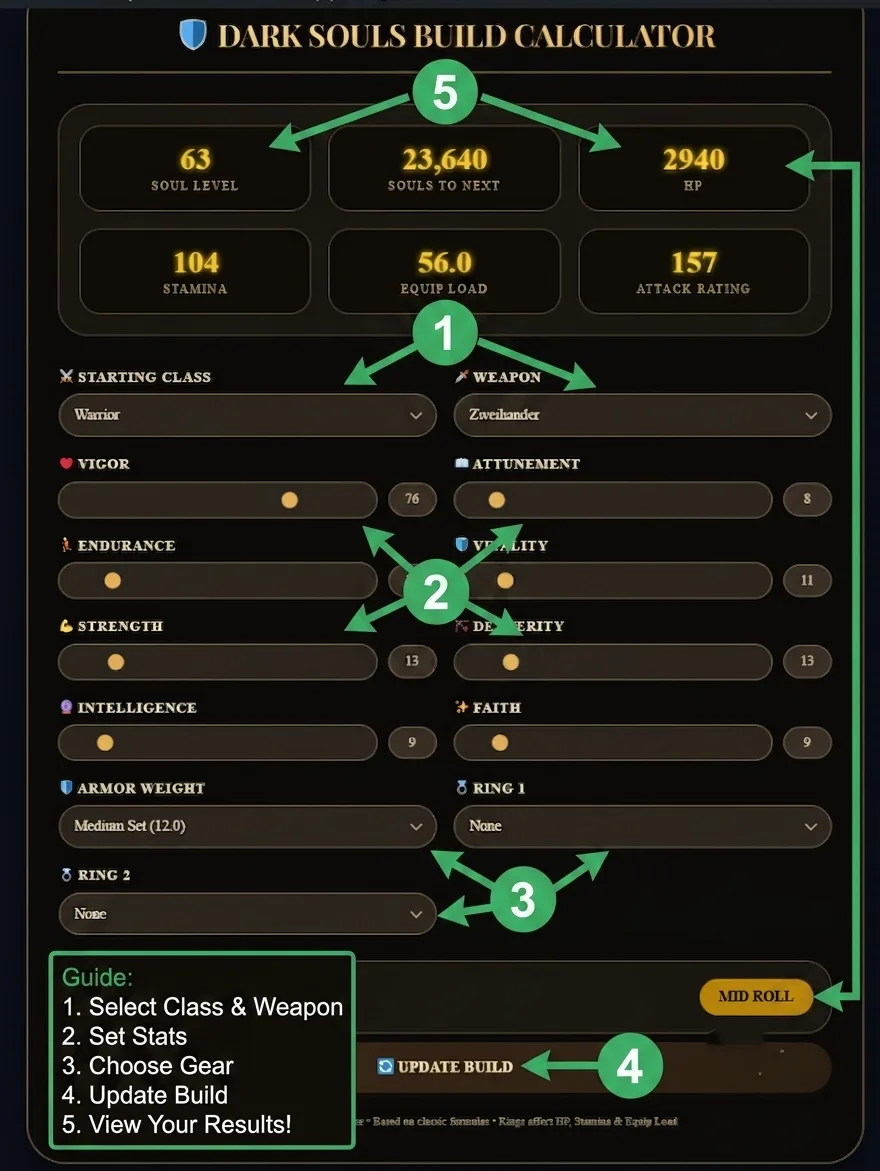
Step-by-Step
- Select a starting class. This sets your base stats and starting Soul Level. See the full class table below.
- Adjust your nine stat sliders (up to 99 each). Soul Level and the souls needed to reach it update instantly.
- Choose a weapon and infusion. Attack Rating is calculated from the weapon’s base damage and scaling letter grade combined with your stats. Toggle two-handing to apply a 1.5× Strength bonus.
- Pick armor for head, chest, hands, and legs. Combined with your Vitality, this determines your Equip Load percentage and roll type.
- Add up to four rings. Effects apply immediately to your stats and equip load.
- Read your results. Soul Level, soul cost, HP, FP, Stamina, Equip Load, Attack Rating, Poise, elemental absorption, and roll type all update automatically.
All 10 Starting Classes — Base Stats
Ghostern’s build system uses ten starting classes, each with its own base stat spread and starting Soul Level.
| Class | SL | VIG | ATT | END | VIT | STR | DEX | INT | FTH | LCK |
|---|---|---|---|---|---|---|---|---|---|---|
| Knight | 9 | 12 | 10 | 11 | 15 | 13 | 12 | 9 | 9 | 7 |
| Mercenary | 8 | 11 | 12 | 11 | 10 | 10 | 16 | 10 | 8 | 9 |
| Warrior | 7 | 14 | 6 | 12 | 11 | 16 | 9 | 8 | 9 | 11 |
| Herald | 9 | 12 | 10 | 9 | 12 | 12 | 11 | 8 | 15 | 11 |
| Thief | 5 | 10 | 11 | 10 | 9 | 9 | 13 | 10 | 8 | 14 |
| Assassin | 10 | 10 | 14 | 11 | 10 | 10 | 14 | 11 | 9 | 10 |
| Sorcerer | 6 | 9 | 16 | 9 | 7 | 7 | 12 | 16 | 7 | 12 |
| Pyromancer | 8 | 11 | 12 | 10 | 8 | 12 | 9 | 14 | 14 | 7 |
| Cleric | 7 | 10 | 14 | 9 | 7 | 12 | 8 | 7 | 16 | 13 |
| Deprived | 1 | 10 | 10 | 10 | 10 | 10 | 10 | 10 | 10 | 10 |
Build tip: Deprived starts flat at 10 in everything, giving full control for min-maxing from Soul Level 1. Knight starts with the highest Vitality, favoring tankier, heavier-armor builds from the outset. Sorcerer starts with the highest Attunement and Intelligence, suited to a pure caster build.
What Each Stat Does
❤️ Vigor — HP
Vigor is your main survivability stat, determining maximum HP. Gains are strongest in the early range and taper off at higher investment — the calculator’s HP curve reflects this directly in the Derived Vitals panel as you adjust the slider.
📖 Attunement — FP and Spell Slots
Attunement raises your maximum FP and unlocks additional spell slots at fixed thresholds: 10, 14, 18, 24, and 30 Attunement each add one slot, for a maximum of 5.
🏃 Endurance — Stamina
Endurance governs your Stamina pool — how many attacks, rolls, and blocks you can chain before running out. In this system, Endurance affects Stamina only; equip load is handled by a separate stat (Vitality, below).
⚖️ Vitality — Equip Load
Vitality determines your maximum Equip Load, which in turn decides your roll type once your gear weight is factored in. This is a separate stat from Endurance in Ghostern’s system — raising Endurance won’t change how much you can carry.
💪 Strength — Physical Weapon Scaling
Strength scales Strength-favoring weapons and unlocks heavier gear. Two-handing a weapon applies a 1.5× Strength multiplier for scaling purposes.
🗡️ Dexterity — Skill-Based Weapon Scaling
Dexterity scales Dexterity-favoring weapons like the Uchigatana and Sellsword Twinblades.
🔮 Intelligence — Sorcery-Infused Weapon Damage
Intelligence scales Intelligence-favoring weapons, most notably the Moonlight Greatsword, and adds bonus magic damage when a weapon carries a Crystal infusion.
✨ Faith — Lightning-Infused Weapon Damage
Faith scales Faith-favoring weapons like the Dragonslayer Greataxe and boosts a weapon’s lightning damage when a Lightning infusion is applied.
🍀 Luck — Available in the Attribute Panel
Luck is included as an allocatable stat for every class but doesn’t currently factor into any of the calculator’s damage or defense formulas — treat it as a stat to leave at class base unless a future update adds an effect for it.
Roll Types — Fast, Mid, Fat, and Overburdened
Your roll type depends on what percentage of your maximum Equip Load you’re currently using.
30% equip load or under.
Up to 70% equip load.
Up to 100% equip load.
Above 100% you’re Overburdened — the calculator will show this directly in the Mobility/Roll indicator. Bring your equip percentage down with more Vitality, Havel’s Ring, Ring of Favor, or lighter armor pieces.
Equip Load tip: The “Auto-Optimize” button resets all four armor slots to their lightest non-naked option (Knight-tier pieces), a quick way to see what a fast-to-mid roll loadout looks like before fine-tuning manually.
Weapons in the Calculator
Eight weapons are available, each with its own base damage, weight, stat requirements, and scaling letter grade (S, A, B, C, D, or E — S is strongest, E is weakest).
| Weapon | Phys | Other | Weight | STR Req | DEX Req | STR Scale | DEX Scale | Notes |
|---|---|---|---|---|---|---|---|---|
| Longsword | 220 | — | 3.0 | 10 | 10 | C | C | Balanced starter |
| Claymore | 276 | — | 9.0 | 16 | 13 | C | C | Quality build |
| Zweihander | 330 | — | 10.0 | 19 | 11 | C | D | Strength-leaning |
| Uchigatana | 230 | — | 5.5 | 11 | 16 | D | C | Dexterity-leaning |
| Sellsword Twinblades | 198 | — | 5.0 | 10 | 16 | D | B | Pure Dexterity |
| Fume Ultra Greatsword | 380 | — | 25.5 | 50 | 10 | S | — | Pure Strength, heavy |
| Moonlight Greatsword | 130 | Magic 260 (INT Scale B, req INT 26) | 10.5 | 16 | 12 | E | — | Pure Intelligence |
| Dragonslayer Greataxe | 364 | Lightning 142 (FTH Scale D) | 20.0 | 40 | 0 | C | E | Strength/Faith hybrid |
Infusions available: Regular, Heavy (+40% to Strength scaling), Sharp (+40% to Dexterity scaling), Refined (+15% to both), Raw, Crystal (adds Intelligence-scaled magic damage), Lightning, and Chaos.
Popular Build Presets
Three ready-made presets are built into the calculator’s dropdown — pick one to instantly load a full stat spread, weapon, and infusion:
GiantDad (The Legend)
Warrior class, reallocated to Vigor 48 / Attunement 10 / Endurance 66 / Vitality 15 / Strength 24 / Dexterity 13 / Intelligence 8 / Faith 9 / Luck 11, wielding a Chaos-infused Zweihander.
Quality Build (40/40)
Knight class, reallocated to Vigor 40 / Attunement 10 / Endurance 35 / Vitality 15 / Strength 40 / Dexterity 40 / Intelligence 9 / Faith 9 / Luck 7, wielding a Refined Claymore.
Pure Sorcerer
Sorcerer class, reallocated to Vigor 27 / Attunement 30 / Endurance 20 / Vitality 7 / Strength 16 / Dexterity 12 / Intelligence 60 / Faith 7 / Luck 12, wielding a Crystal-infused Moonlight Greatsword.
Armor in the Calculator
Four armor slots — head, chest, hands, legs — each with a “Naked / None” option plus real weight and Poise values:
- Head: Knight Helm, Fallen Knight Helm, Havel’s Helm, Crown of Dusk (this last piece reduces magic absorption significantly in exchange for its look — a genuine trade-off, not a bug).
- Chest: Knight Armor, Fallen Knight Armor, Havel’s Armor.
- Hands: Knight Gauntlets, Havel’s Gauntlets.
- Legs: Knight Leggings, Havel’s Leggings.
The full Havel’s set carries the highest weight and Poise of any combination in the tool, at the cost of a much higher Equip Load percentage — expect Fat Roll or worse without significant Vitality investment or Havel’s Ring.
Rings in the Calculator
Four ring slots, chosen from:
- Havel’s Ring — +15% Equip Load.
- Ring of Favor — +3% HP, +8.5% Stamina, +5% Equip Load, all at once.
- Prisoner’s Chain — +5 to Vigor, Endurance, and Vitality together.
- Knight’s Ring — +5 Strength.
- Hunter’s Ring — +5 Dexterity.
- Scholar Ring — +5 Intelligence.
- Priestess Ring — +5 Faith.
Why the Calculator Works This Way
Real-time updates matter because dragging a slider and watching your roll type change instantly is far more useful for planning than clicking “Calculate” and waiting. The Mobility/Roll badge sits at the top of the results because it’s the number most build-planners check first. Soul cost between levels uses a smooth cubic-based cost curve rather than a flat per-level number, so the total reflects how much more expensive high-level respecs become — consistent with how the genre’s leveling curves generally behave, even though the exact figures here are Ghostern’s own.
About the Author
Frequently Asked Questions
Is this an authentic Dark Souls 1 calculator?
No — it’s Ghostern’s own build-planning system, inspired by Dark Souls’ class structure and equip-load mechanics, with its own classes, weapons, and stat formulas rather than the original game’s exact figures.
How many stats does this build system use?
Nine: Vigor, Attunement, Endurance, Vitality, Strength, Dexterity, Intelligence, Faith, and Luck.
What’s the difference between Endurance and Vitality here?
Endurance controls your Stamina pool. Vitality controls your Equip Load capacity. They’re separate stats — raising one won’t affect the other.
What’s the difference between fast, mid, and fat roll?
Fast roll is 30% equip load or under; mid roll goes up to 70%; fat roll goes up to 100%. Above 100% you’re Overburdened.
Is this calculator free?
Yes — no signup, no watermark, no limit on how many builds you plan.
What classes are included?
Knight, Mercenary, Warrior, Herald, Thief, Assassin, Sorcerer, Pyromancer, Cleric, and Deprived — see the full base-stat table above.
What rings are included?
Havel’s Ring, Ring of Favor, Prisoner’s Chain, Knight’s Ring, Hunter’s Ring, Scholar Ring, and Priestess Ring, across four ring slots.
Is this affiliated with FromSoftware or Bandai Namco?
No — independent fan-inspired tool, not affiliated with or endorsed by FromSoftware, Bandai Namco, or any publisher.
What does Luck do in this calculator?
Currently nothing — it’s allocatable on every class but isn’t factored into any damage or defense formula yet.
How does weapon scaling work here?
Each weapon has a letter grade (E through S) per relevant stat. S multiplies bonus damage the most, E the least — the exact multipliers are S=1.4×, A=1.0×, B=0.75×, C=0.45×, D=0.25×, E=0.10× applied to the stat’s scaling curve.
What does two-handing a weapon do?
It applies a 1.5× multiplier to your effective Strength for that weapon’s scaling calculation only.
Can I share a build I’ve made?
Click “Share” to copy the current page link, letting you send your build setup to someone else.
More FromSoftware-Inspired Tools from Ghostern
A note on accuracy: This is an original build system inspired by the Souls genre, not a reproduction of any single game’s exact stats, weapons, or formulas. Numbers here reflect Ghostern’s own design and won’t match the original Dark Souls 1.
Built and maintained by Sharjeel at Ghostern.
📅 Last updated: September 2026 · First published: June 2025
Privacy Policy · Terms of Service · Contact
Dark Souls, FromSoftware, and related names and trademarks belong to their respective owners. This is an independent fan-inspired tool, not affiliated with or endorsed by FromSoftware or Bandai Namco.